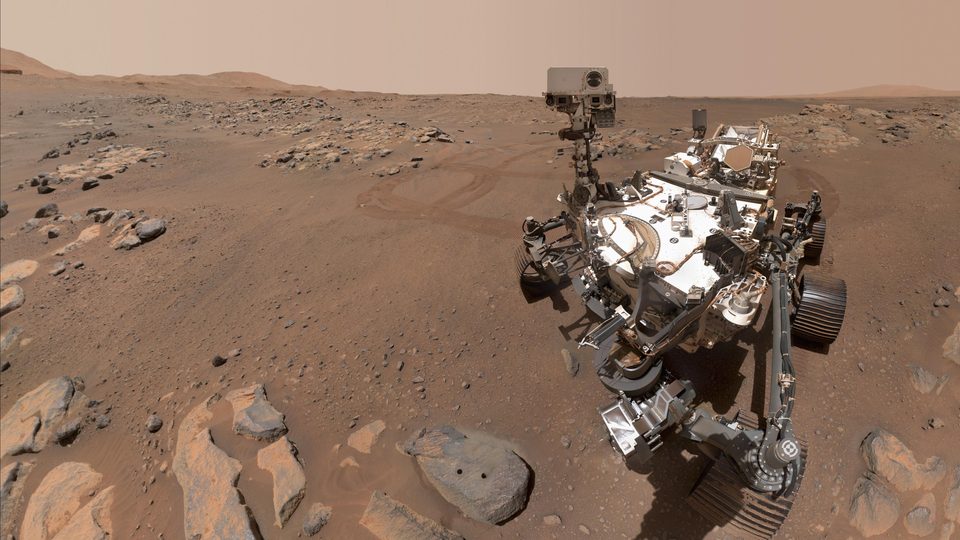
NASA's Perseverance rover has now driven farther than any vehicle on another world. On 11 October 2026, the 2,006th Martian day of its mission, its total distance reached 45.22 kilometres (28.10 miles), passing the 45.16 kilometres (28.06 miles) driven by NASA's Opportunity rover between 2004 and 2018. NASA announced the record on 12 October.
Perseverance landed in Jezero Crater in February 2021. Steven Lee, project manager for the Curiosity and Perseverance rovers at NASA's Jet Propulsion Laboratory, says the original mission called for no more than 12.4 miles (about 20 kilometres) of driving, and he expects the rover to keep adding to the record for many years.
Most of the distance was covered by AutoNav, the rover's self-driving system. As it drives, Perseverance photographs the ground ahead, builds a 3D map of hazards and plans its own route between waypoints set by the team on Earth, which the team calls "thinking while driving". More than 90% of its distance was driven this way, against about 5% for Spirit and Opportunity, which carried the first Martian version. Sojourner, the first Mars rover, judged the path ahead from 20 measurement points; Perseverance processes 600,000 each time it looks, and can cover up to 412 metres in a single Martian day.
The rover is now heading for an area called Idubi, beyond the western rim of Jezero Crater, where the team hopes to find traces of ancient hydrothermal systems in some of the oldest terrain yet explored. It will then follow the crater rim south towards a site called Rainbow Falls.
Rover autonomy sits where computer science meets engineering, and both pages list funded routes. For more from NASA this month, see the last test telescope for the LISA gravitational-wave observatory.