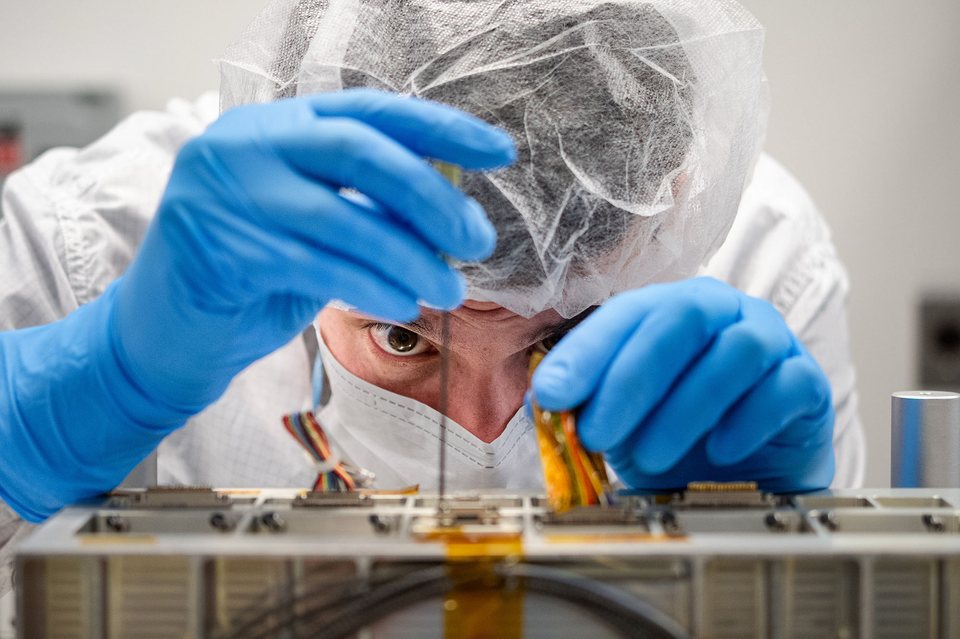
NASA announced on 8 October that it has taken the next step towards the telescopes it is building for LISA, the Laser Interferometer Space Antenna. L3Harris Technologies will design, assemble and integrate a new Engineering Test Unit, the last step before flight hardware is produced. NASA says it will be the final pre-flight unit and its first optical telescope delivery to the European Space Agency.
LISA is led by ESA and is due to launch in the mid-2030s. Three spacecraft will fly in an Earth-following orbit, forming a triangle about 2.5 million kilometres on each side. Each carries two telescopes that send and receive infrared laser beams between the spacecraft. Passing gravitational waves will change the distances between them by less than the width of a helium atom, and LISA is designed to measure exactly that.
From space, LISA can pick up low-frequency gravitational waves that observatories on Earth cannot. NASA expects it to detect mergers of giant black holes billions of light-years away, map close pairs of white dwarfs, neutron stars and smaller black holes in our own galaxy, and perhaps reveal something new about gravity itself.
Each telescope is made entirely of Zerodur, an amber-coloured glass-ceramic that barely changes shape as temperatures swing. L3Harris delivered a prototype to NASA's Goddard Space Flight Center in 2024, and in June 2026 the team delivered a structural model made of metal. Lessons from testing both are going into the new unit.
Einstein predicted gravitational waves in 1916, and observatories on the ground first detected them in 2015. Inside each LISA spacecraft a gold-platinum cube will fall freely, shielded from every force but gravity; ESA's LISA Pathfinder mission showed in 2016 that this can be done. NASA is also supplying the laser system, devices that control electric charge on the cubes, and data analysis.
This week's Nobel Prize in Physics went to another way of watching the violent universe, through neutrinos. For funded research in astrophysics, Lund University is advertising a salaried PhD in astronomy and astrophysics, and our guide to how funded PhDs work in Europe explains how posts like it work.